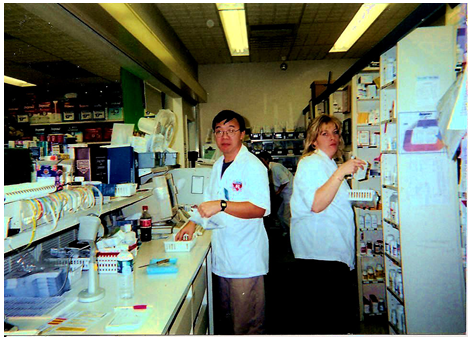
Photo caption: Colchicine has been a medicine for gout for several hundred years, long before the existence of FDA. It was inexpensive and effective, but did not have FDA’s approval. In 2006, FDA launched the Unapproved Drug Initiative. This program required that all the old drugs being in clinical use, but without FDA’s approval must go through the process of clinical trials to provide data of the safety and effectiveness, just like the requirement for approving a new drug. One pharmaceutical company spent tons of money for the clinical study on colchicine for the required data. In exchange, the company obtained the monopoly pricing right from FDA. I remember, the price for a prescription of colchicine for a week supply costed less 5 dollars prior to 2009. Upon the company had the approval from FDA, one prescription for colchicine for one week supply costed more than 300 dollars, within a week.
I have been asked to write a blog about gout recently. One friend of mine said to me that so many Chinese friends she knew were suffering gout, “Perhaps you can find some helpful information , so they may be better in controlling their pain.” I have heard story again and again that patients with gout refused taking medicines, particularly uric acid-lowering drugs. They would rather seek for helps from herbs, or anti-inflammatory medicine for gout acute attack, but reject chronic treatment to address the issue of their high uric acid levels. Side effects of uric acid – lowering drugs, of course, are the primary cause of reluctance of taking those medicines. On another hand, perceptions on medicine may play a role, such as the saying of “All drugs are toxins. “ My comments perhaps may be like: Anything injected by any rout to our bodies could be harmful or toxic if it is not administered properly, for examples, water, or dietary salt—- you name it. How about air that we breathe in? Hyperventilation can quickly knock you down too. The logical thinking is to assess the benefit/risk ratios (for example: if I take this medicine, I may or may not have diarrhea but I was told my pain will be gone in an hour , should I take the medicine?) and take medicine correctly, based on real clinical data. For the treatment of gout, if we are able to choose a correct dosage, a correct drug combination, or a correct length of treatment course, side effects of uric acid lowering drugs will be greatly alleviated, patients then have no troubles of taking them. Therefore, I have done some readings, and written this study note, to share.
Medicines for Gout Acute Attacks
Generally, there are four groups of medicines for the pain and inflammation of acute gout attack. They are Nonsteroidal anti-inflammatory drugs, corticosteroid, colchicine, adrenocorticotropic hormone (ACTH).
Colchicine has long been used for the treatment of gout flare. It has the anti-inflammatory effects by affecting the cellular motility, exocytosis and other cellular functions of immune cells. Because colchicine has the different mechanism of anti-inflammation from NSAIDS, it can be used in combination with NSAIDS for severe acute attack.
At present, the recommended dosing is to take 1.2 mg at the early sign of acute attack, then 0.6mg one hour later. After this dosing for acute attack, patients need to wait 12 hours to start a prophylaxis dosing, which is 0.6 mg once or twice daily. If one day acute treatment is not enough, patients need to wait at least 3 days to have another acute treatment. This regimen is much more tolerable compared to the high dosing in the past.
Years ago, prescriptions of colchicine for gout flare would usually have different instruction. Patients were instructed to “ take 1.2 mg ( 2 tablets of 0.6 mg tablet by mouth at the first sigh of flare, then take one tablet ( 0.6mg) every one hours thereafter for 6 hours or until having diarrhea or can’t tolerate side effects” . Those days, when I dispensed prescriptions for colchicine, I always wondered how anyone liked taking the medicine!
Compared the old high dosing, the present colchicine dosing for gout acute attack have similar efficacy and its side effects are not different from that of placebo.
Colchicine has drug interaction with some heart medicines like verapamil, diltiazem, digoxin, anti-HIV medicines and some other drugs in a class of CYP3A4 inhibitors.
Nonsteroidal anti-inflammatory drugs include naproxen, indomethacin, ibuprofen and others. They are more preferable over colchicine in treating acute gout attacks because they have less side effects. (note: Tylenol ( acetaminophen ) is not a NSAID drug ). In a clinical trial, the effects of pain relief from taking naproxen 750mg loading dose then 250mg every 8 hours for 7 days, compared to that taking colchicine 0.5 mg three times per day for 4 days were basically the same. It is recommended that NSAIDs drugs are used in full dose for 2- 5 days until acute attack is under control, then tapering the dose for about 2 more weeks. When the symptoms of acute attack are gone, wait for 2 more days before discontinuation of the acute regimen. The tapering process is to prevent the rebound of symptoms.
Aspirin is a NSAID drug, but Aspirin should not be used for gout flare. Aspirin can change uric acid level and make an acute attack worse.
Prednisone is a corticosteroid drug. Its regimen for a gout acute attack covers 2 weeks of tapering process. Treatment can be started with course of a 40mg daily for the first 3 days, the following dose gradually tapered every 3 days and the course completed at day 14. Prednisone can be used when patients cannot tolerate NSAIDS or colchicine.
Drugs are used in combinations. In cases of severe acute attack, when one single drug is not able to provide the relief of inflammatory symptoms, an additional drug can be considered for a combination of drug treatment. The appropriate combinations recommended in the guideline of American College of Rheumatology are: colchicine used with NSAIDS such as naproxen; colchicine used with oral corticosteroid such as prednisone; intra-articular steroids injection (such as dexamethasone) used with colchicine or NSAIDS.
There are other classes of medicine are effective in treating gout acute attack. Subcutaneous injection of ACTH is effective, similarly to corticosteroids like prednisone, but unlike prednisone, ACTH does not have the issue of suppressing endogenous corticosteroid production. Anakinra is also a subcutaneous injectable medicine which is highly effective with few side effects . But you rarely see prescriptions of these drugs written by physicians. They are probably too expensive and inconvenient to administer.
Medicines for Chronic Gout
How long is uric acid lowering therapy supposed to be?
If a patient has experienced the first gout acute attack, after a successful acute treatment, he may become symptom-free. Does he still need a drug treatment to lower his uric acid? The urate lowering therapy is actually recommended. The concept is to lower the risk of further inflammatory acute attack, to protect bones, kidney from the destructive injury by uric salt deposition. The strategy of lowering urate includes avoiding purine-rich foods and alcohol, adjustment of medications that may elevate urate level, etc. in addition to use urate lowering agents. The target of uric acid level in the urate lowering therapy is 6 mg/dL, or lower. Through treatment patients who are free of all acute or chronic symptoms, including the resolution of last tophus, should still continue the urate lowering therapy indefinitely. However, the necessity of this approach has been questioned by some other physicians.
What are the most commonly used types of urate lowering drugs ?
Two classes of the most commonly used urate lowering agents are uricosuric (such as probenecid) and xanthine oxidase inhibitors ( allopurinol and febuxostat). Uricosurics –probenacid lowers uric acid level by increasing the excretion of uric acid from blood through kidney into urine. Xanthine oxidase inhibitor-allopurinol lowers the uric acid in blood by inhibiting the production of uric acid from purine. Both are able to lower uric acid level, which one is better given to what patients? There are some recommendations such as: Patients having urinary excretion of urate less than 800mg within 24 hours on unrestricted diet are those considered be given probenecid. Patients having kidney disease should be given febuxostat, or allopurinol . Probenecid can also be used in a combination with allopurinol for some patients, if allopurinol used as a single drug therapy is not able to lower uric acid sufficiently. Urinary alkalization is also recommended, such as taking potassium citrate.
How to prevent the gout flare caused by urate lowering drugs? With colchicine or NSAIDs
When the uric acid levels in the blood are altered abruptly by taking urate lowering drugs, it may trigger worse acute gout attacks. Either xanthine oxidase inhibitors ( allopurinol , febuxostat ) , or uricosuric drugs (probenecid, aspirin etc.) , have this unpleasant problem. The approach to combat this issue is prophylaxis. Colchicine or NSAIDS at low dose is given for at least 6 months when urate lowering therapy is initiated. It has been reported that colchicine lower the risk of flares in urate lowering therapy by 85 %. Long term use of colchicine may cause bone marrow suppression and other serious side effects. I may think NSAIDS like naproxen more preferably, or periodical alternation of these two drugs. There is another note in dealing with this issue. After the urate lowering therapy is initiated, a gout flare may be triggered, in this case, the urate lowering agent should not be discontinued. Otherwise, symptoms may get worse.
What is the recommended regimen of allopurinol ? How is it compared with febuxostat?
For patients without pre-existing conditions of heart or kidney diseases, most are given allopurinol 100 mg per day as starting dose, then dosage increases every 2-5 weeks until uric acid level reaches 6 mg/dL or less. After target level of uric acid is achieved, the same dose of allopurinol should be maintained for 6 month and stop colchicine which is used to reduce risk of the precipitation of acute attack triggered by allopurinol. The maximum dosage of allopurinol is 800 mg per day for patients without kidney disease according to FDA. For patients with kidney disease, the dosage needs to be reduced.
Compared with allopurinol, febuxostat does not require dose adjustment in patients with kidney disease because it is metabolized in liver. Febuxostat is is also better than allopurinol in lowering blood uric acid levels . When the endpoint of therapeutic results were set as achieving uric acid level of 6 mg/dL or less by 6 months, 45% of patients treated with 40 mg febuxosate daily reached the therapeutic goal, 67% with febuxostat 80 mg daily, 42% with allopurinol 300 mg daily (or 200mg daily for patients with kidney disease) . The maximum daily dosage of allopurinol is 800 mg , why was only 300 mg daily used in the clinical study? The investigators explained and cited previous studies that 300 mg allopurinol daily works basically as effective as 600 mg daily.
Gradually increasing febuxostat dosage lower the risk of gout flares
An approach of gradual dose increment lowers the risk of undesired precipitation of acute attack triggered by febuxostat itself, as mentioned earlier. Starting dose is 10 mg per day for 4 weeks, then double the dose every 4 weeks until reach 40 mg per day. This approach is helpful because patients do not have to take colchicine or naproxen. If the high dose, such as 40 mg per day, is to start, then the prophylactic use of colchicine or naproxen may be needed. There are other drugs with different mechanisms of action in lowering uric acid levels, such as lesinurad, pegloticase. They are powerfully effective. But I have been wondering, how many people are able to offer them.
Key Ref:
Reinders MK, Haagsma C, Jansen TL, van Roon EN, Delsing J, Laar MA van de, Brouwers JR. A randomised controlled trial on the efficacy and tolerability with dose-escalation of allopurinol 300-600 mg/day versus benzbromarone 100-200 mg/day in patients with gout. Ann Rheum Dis. 2009;68:892–897.
[ Guideline] Khanna D, Fitzgerald JD, Khanna PP, Bae S, Singh MK, Neogi T, et al. 2012 American College of Rheumatology guidelines for management of gout. Part 1: Systematic nonpharmacologic and pharmacologic therapeutic approaches to hyperuricemia. Arthritis Care Res (Hoboken). 2012 Oct. 64(10):1431-46.
[Guideline] Khanna D, Khanna PP, Fitzgerald JD, Singh MK, Bae S, Neogi T, et al. 2012 American College of Rheumatology guidelines for management of gout. Part 2: Therapy and anti-inflammatory prophylaxis of acute gouty arthritis. Arthritis Care Res (Hoboken). 2012 Oct. 64(10):1447-61.
[Guideline] FitzGerald JD, Dalbeth N, Mikuls T, et al. 2020 American College of Rheumatology Guideline for the Management of Gout. Arthritis Care Res (Hoboken). 2020 Jun. 72 (6):744-760.
Roddy E, Clarkson K, Blagojevic-Bucknall M, Mehta R, Oppong R, Avery A, et al. Open-label randomised pragmatic trial (CONTACT) comparing naproxen and low-dose colchicine for the treatment of gout flares in primary care. Ann Rheum Dis. 2020 Feb. 79 (2):276-284.
Terkeltaub RA, Furst DE, Bennett K, Kook KA, Crockett RS, Davis MW. High versus low dosing of oral colchicine for early acute gout flare: Twenty-four-hour outcome of the first multicenter, randomized, double-blind, placebo-controlled, parallel-group, dose-comparison colchicine study. Arthritis Rheum. 2010 Apr. 62(4):1060-8.
Cipolletta E, Di Matteo A, Scanu A, Isidori M, Di Battista J, Punzi L, et al. Biologics in the treatment of calcium pyrophosphate deposition disease: a systematic literature review. Clin Exp Rheumatol. 2020 Sep-Oct. 38 (5):1001-1007.
Kelly JC. Gout doubt: Experts challenge new ACP guidelines. Medscape Medical News. Available at http://www.medscape.com/viewarticle/871265. November 2, 2016; Accessed: November 23, 2016.
Yu T. The efficacy of colchicine prophylaxis in articular gout–a reappraisal after 20 years. Semin Arthritis Rheum. 1982 Nov. 12(2):256-64.
Becker MA, Schumacher HR, Espinoza LR, Wells AF, MacDonald P, Lloyd E, et al. The urate-lowering efficacy and safety of febuxostat in the treatment of the hyperuricemia of gout: the CONFIRMS trial. Arthritis Res Ther. 2010. 12(2):R63.
Yamanaka H, Tamaki S, Ide Y, Kim H, Inoue K, Sugimoto M, et al. Stepwise dose increase of febuxostat is comparable with colchicine prophylaxis for the prevention of gout flares during the initial phase of urate-lowering therapy: results from FORTUNE-1, a prospective, multicentre randomised study. Ann Rheum Dis. 2018 Feb. 77 (2):270-276.
My Study Notes taken from Medscape, Pharmacists’ letters, Gold Standard of pharmacology.
 PurenHealthInfo.com