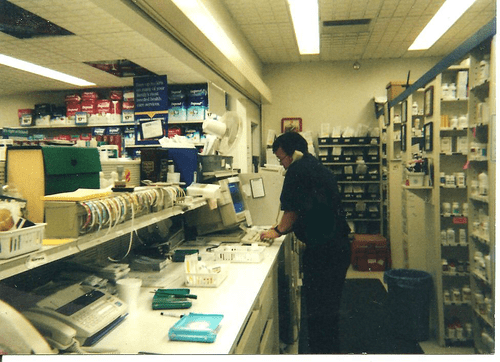
Photo caption: Gastroesophageal reflux is one of most common subjects that patients’ seeking for consultation in pharmacy. Many helpful medicines are available in over-the-counter. With a piece of good advice, a patient may start his self-treatment for a mild condition, and have a good result. The photo is a snap shot of an ongoing phone consultation. It looked like that this pharmacist may have had problems for his pay-raise next year as he was not following the required dress code at work.
I remember in those years of 70’s, my father had a bottle of white power and he took the powder by mouth when he felt sick. This powder had nothing to do with those magic shits making people off mind flying into galaxy. It was the grinded shells of chicken eggs. The therapeutic armamentarium for GERD was so scarce, people had no choice but became inventive. The shells of chicken eggs are made of calcium carbonate, the same ingredient of Tums for GER that we found in pharmacy over-the-counter at present time. Science is advancing. There are many effective medicines for GER nowadays, either prescription drugs or Over-The-counter drugs. When a pharmacist has a patient’s consultation for heart burns, the outcome of the consultation is almost always satisfactory, which means in a week also , he would most likely receive a call saying “Thank you”, a hand shake or a hug from the patient. The patient’s symptoms of heart burns are gone. Did the pharmacist know with certainty that he was dealing with issues of GER? Approximately 80% of patients have a recurrent but nonprogressive form of GERD that can be controlled with medications.
According to ACG guidelines, a presumptive diagnosis of GERD can be made in the setting of typical symptoms of heartburn and regurgitation. Empirical medical therapy with a PPI is recommended in this setting. For example, a patient’s symptoms of GER resolve after taking Nexium, then it may be concluded the patient has the conditions of GER. The bottom line is that symptoms of GER can be resolved quickly by easily accessible medications. Meanwhile, for clinicians, identifying the 20% of patients who have a progressive form of the disease is important, because they may develop severe complications.
For the management of GER, there are recommendations of lifestyle changes
- Losing weight (if overweight)
- Avoiding alcohol, chocolate, citrus juice, and other acidic foods
- Avoiding peppermint, coffee
- Eating small, frequent meals rather than large meals
- Waiting 3 hours after a meal to lie down
- Refraining from ingesting food (except liquids) within 3 hours of bedtime
- Elevating the head of the bed by 8 inches
Those measures should be helpful, but people do not pay much attention to them, perhaps it is because the current available medications work so fast, so well.
Medications
Antacids. There are many brands or formulations. Antacids reduce the acidity of reflux but not its frequency. These drugs, which include calcium carbonate, aluminum hydroxide and magnesium hydroxide, are typically taken by patents for mild GERD symptoms after meals and at bedtime. Depending on the antacid chosen, they may also afford relief for constipation or loose stools. Tums ( like chicken egg shells) has calcium carbonate stops heart burns quickly. Tums also is considered as sort of calcium supplement. Mylanta One chewable tablet may be a better antacid, it has calcium carbonate and magnesium hydroxide. Magnesium hydroxide, in addition to be a base neutralizing gastric acid, is a laxative, which helps to overcome the constipation caused by calcium carbonate. Antacids are not really drugs of choice when many other drugs are more effective available in the present therapeutic armamentarium.
H2 receptor antagonists. When histamine secreted by stomach cells, it activates histamine type 2 receptors in a type of cells called parietal cells producing gastric acid, gastric acid is secreted into stomach. Proper amount of gastric acid is needed for food digestion. Too much gastric acid can cause GERD, esophagitis, gastric duodenal ulcer. H2 blockers inhibit the interaction between histamine and its H2 receptors, resulting in the reduction of the secretion of gastric acid.
Ranitidine was the first drug of its class. In the age of using chicken egg shells for gastric ulcer, its effectiveness had gloriously changed the landscape of pains caused by gastric ulcers, GERD. But it is off the market now. Famotidine seems more commonly used than cimetidine or nizatidine. This class of drugs is used for mild to moderate symptoms. Because gastric acid is erosive, its reflux from stomach to esophagus can cause esophagitis. H2 receptor antagonists are effective for healing mild esophagitis in 70- 80 % of patients with GERD. This is pretty good but not as good as PPI drugs. For self -treating hart burns, famotidine is usually taken 20 mg once daily (or 10 mg twice a day) 30 min before meal for 2 weeks. For esophagitis, the regimen is 20mg twice daily for 6 weeks. For Duodenal, gastric ulcers, 40mg daily at bed time. Most patients heal after 4 weeks, but treatment can be as long as 6 months. After initial treatment phase, maintain treatment of 20 mg daily at bedtime to prevent relapse.
Proton Pump Inhibitors (PPI). This class of drugs is the more effective drugs than H2 antagonists for GER/GERD treatment. What is proton pump? Hydrogen potassium ATPas is the real long name of proton pump. Hydrogen without its electron is proton, it has a positive charge (H+ ). When proton pumps transport protons from parietal cells out into stomach, protons become gastric acid. PPIs attack proton pumps, make the pumps unable to produce gastric acid, leading to less amount of gastric acid in stomach. PPIs include omeprazole, lansoprazole, rabeprazole, esomeprazole, pantoprazole. They are the most powerful medications for GER/GERD treatment. When H2 antagonists are not sufficiently effective for GER/GERD symptoms, PPIs are the options. Omeprazole is most commonly used in its class. For symptomatic GERDs (without esophagitis lesion), omeprazole 20 mg 30 min before meal in morning daily for up to 4 weeks. For symptomatic GERD with esophagitis, same dose treatment for 8 weeks and may be up to 48 weeks or longer. For some patients, chronic therapy with omeprazole may be needed. This is to prevent relapse, which occurs commonly. The maintenance dose is 20 mg daily. Esomeprazole is superior to omeprazole and other PPIs in the treatment of GERD. However, due to its much higher cost, its use is next to omeprazole.
There are two frequent issues about the regimen of PPI that I used to scramble to find answers in patient consultation.
One is the relapse of GER symptoms occurring shortly after the ends of PPI treatment. To deal with relapse, patients would restart taking a PPI again, for example, restarting omeprazole, either at higher dose, longer terms of treatment, or switched to another PPI drug such as esomeprazole. When physicians opt to maintenance regimen for patients according the instructions from monograph, patients may continue omeprazole endlessly. Patients have to bear the cost burdens of the medicines, not to mention that those hazardous risks, in some reports, associated with long term use of PPI ( before the conclusion that PPI are safe by ACG Guideline in 2021) The problem is that you do not see drug monographs providing instructions to address this issue. Dose tapering is the common approach in discontinuation of some medicines. Corticosteroids (such as prednisone) dose tapering to discontinuation helps to alleviate its suppression of natural production of corticosteroids, Tapering anti-psychotics’s dose ( such as diazepam) to prevent psychiatric symptoms rebound if a drug discontinuation is required. Can the dose tapering approach be applied for omeprazole or other PPIs in the case as well? The pharmacological mechanism of irreversible binding to Proton Pumps of PPIs and the all the known physiological sensor-feedback-adjustment systems through nervous / hormonal self-intervention to maintain the proper secretion of gastric acid should provide the basis of the approach of tapering dose for the discontinuation of omeprazole or other PPIs. I discussed my suggestion in a few patients’ consultation, the outcomes were successful. Patients were able be off their PPIs (most of them had been on chronic therapy of esomeprazole for years) without symptom rebound. After the chronic therapy is discontinued, omeprazole (or another PPI), or H2 antagonist, famotidine can be taken only as needed (for one day to a few days if patients experience signs of symptoms ). As a result, there would be smiles and handshakes over the next consultation. When studied the updated guideline recently, I noticed the guideline addresses clearly the approach of deprescribing PPIs , “ Guidelines for deprescribing PPIs suggest that adults with upper GI symptoms who have completed a minimum 4-week course of PPI treatment, resulting in resolution of upper GI symptoms, can decrease the daily dose or stop and change to on-demand use. Deprescribing guidelines do not include patients with Barrett esophagus, severe esophagitis”. Upon reading this, I felt my suggestion of the approach of tapering dose was not bad at all.
Another is the concern with some dangerous risks associated with PPIs. There have been some clinical studies that claimed in high doses and long term use of PPIs increasing the risk of gastric cancer, when compared with H2 antagonists. Other studies did not agree. While researchers were debating whether the risk was real or not, the warning is listed in the patients’ consultation list. No doubt, the warning is a frightening one. However, the American College of Gastroenterology (ACG), published Guideline in 2021 regarding the adverse effects of PPI. Guideline suggested physicians and pharmacists telling patients that PPI are the most effective medication treatment for GERD. There have been reports about the severe adverse conditions, like intestinal infections, stomach cancer, osteoporosis, vitamin deficiency etc. Clinicians should point out these studies have flaws, are not considered definitive, and do not establish a cause-and-effect relationship between PPI and the adverse conditions. The Guideline suggests that clinicians should let patients know PPIs are safe. High-quality studies have found that PPIs do not significantly raise the risk of any of these conditions except intestinal infections. There are some other side effects, when PPIs in long term use for esophagitis, should be titrated to the lowest symptomatically effective dose. This new guideline, no doubt, will make those who are on PPI regimen sleep better at nights.
Guidelines are important for clinicians in their practice. They are updated every a few years, usually very lengthy. if you had done a survey on how many mid-level clinicians studied guidelines pertinent to their practice, the result would probably be disappointing. Most of times, the updated clinical information are obtained from required lessons of continued education, which coverages are usually limited. In the cases that there were no answers given in those lessons, your consultations for patient’s questions are based on your knowledge of basic physiology, pharmacology, or other basic health science. I am glad that my suggestion of tapering dose in “de-prescribing PPIs” drugs in patients’ consultation was proved not incorrect in the later year by the new guideline.
Dealing with regurgitation
Prokinetic agents. This class of medications includes meiclopramide, bethanechol , having no effect of suppressing gastric acid. There are others such as cisapride and domperidone used in some countries, bu banned in U.S. due to the risk of cardiac arrest. This class of medicines improves the motility of esophagus and stomach, increases the lower esophageal sphincter pressure, which means that esophagus and stomach keep moving the food contents downward to intestine, and the esophageal sphincter acts as one way valve not letting food contents move upwards from stomach to esophagus. Therefore they are effective in treating regurgitation. Bethanechol has an undesired effect of increasing secretion of gastric acid. So Mitoclopramide is the common choice in this class. The regimen of metoclopramide for GERD includes: 10 — 15mg tablet every 6 hours 30 minutes before meals and at bedtime. For intermittent symptoms, single doses up to 20 mg prior to the provoking situation. Long term use ( 12 weeks) should be avoided. Occasionally, I saw some patients suffer frequent food regurgitation brought prescriptions of baclofen , and it was helpful.
Ref:
Jai Moo Shin 1, George Sachs; Restoration of acid secretion following treatment with proton pump inhibitors Gastroenterology. 2002 Nov;123(5):1588-97. doi: 10.1053/gast.2002.36593.
Waheed Asghar, Elliot Pittman, and Fakhreddin Jamali. Comparative efficacy of esomeprazole and omeprazole: Racemate to single enantiomer switch. Front. Physiol., 12 December 2019
Ka Shing Cheung 1, Esther W Chan 2, Angel Y S Wong 2, Lijia Chen 1, Ian C K Wong 2 3, Wai Keung Leung , Long-term proton pump inhibitors and risk of gastric cancer development after treatment for Helicobacter pylori: a population-based study Multicenter Study Gut . 2018 Jan;67(1):28-35. doi: 10.1136/gutjnl-2017-314605. Epub 2017 Oct 31.
Kobayashi J, Uchida H, Ito J. Proton pump inhibitors and gastric cancer: association is not causation. Gut. 2019 Jun;68(6):1131. doi: 10.1136/gutjnl-2018-316592. Epub 2018 May 25.
The guideline of the American College of Gastroenterology (ACG), published online November 22 , 2021i n the American Journal of Gastroenterology
My Study Notes taken from Medscape, Pharmacists’ letters, Gold Standard of pharmacology.
 PurenHealthInfo.com