Yi-Hui Lin 林宜辉
— Hui-Zheng, Lin was born in 1905. She was the eldest of her seven siblings. At the age of 25, she left home and spent the rest of her life for 30 years as a Christian nun. She had never married. Younger generations in Lin family have always been curious about her life. This article written by Yi-Hui leads us to the understanding of Aunt Hui-Zheng. Some opinionated comments in this English version were reflections from the translator. –Baxi Lin
–Dear Cousin Yun-Hui: To my knowledge, in the late 50’s on behalf of Aunt Yin and Uncle Chao you paid a visit to Aunt Hui-Zheng in the Convent of Tai Shang. This is my recent article for the memoriam of Aunt Hui-Zheng. Your comments would be greatly appreciated. —Yi-Hui
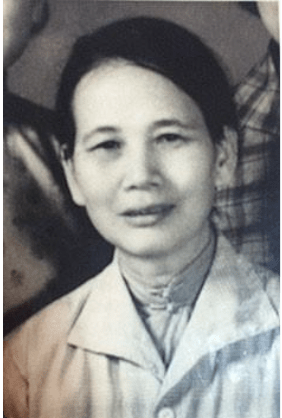
Long after Aunt Hui-Zheng became a Christian nun, my eldest brother Rong-Hui came across Aunt Hui-Zheng’s previous school works. One of her essays, my brother remembered, was titled “He Verses She”. The then-school girl in this essay started as such: Of the written character of Chinese language, the composition of “He” has the component representing “human”. This component does not exist in the composition of “She”. Why? In the five thousand years of Chinese history, had ever been women de facto respected as human? She gave examples, one after another, of the abuses against women. She discerned the cultural causes of women’s inferior social status and smashed the “ancient civilization” that had always been bragged about by many as the national pride. She appealed Chinese women to stand up to fight for their rights, be independent, and thrive themselves. Previously, my brother knew little about Aunt Hui-Zheng. She left her family before he was born. He had never realized how knowledgeable Aunt Hui-Zheng was in Chinese literature and history. Even more surprisingly, she was such an active thinker on social issues, which was contrary to what he had expected for a nun. My brother talked to me years later about this article, commenting that had Aunt Hui-Zheng not been a nun, she might have been an avid advocate of women’s right.
According to my father, Aunt Hui-Zheng was the brightest among her siblings. My father was Aunt Hui-Zheng’s second younger brother after Uncle Chao. While studying in Ji Mei Normal School of Xia Men, she was the top student of her class. Xia Men is a metropolitan city of another province, about 200 miles away from her hometown Jie Yang. Every year, Aunt Hui-zheng returned home in Jie Yang during school breaks with scholarship awards. It had been forever before that all women had to be in their long hair for the identity of their femininity. In one school year however, the people of her village Jiang Xia learned that the girl Hui-Zheng had cut her hair short. The news spread around, villagers were shocked in shame and anger. Her aunt, Yi-He ( her father’s sister) could not help crying out, “Did Hui-Zheng lose her mind!” . The girl Hui-Zheng’s shameful act could not go without punishment, so her aunt
Yi-He made a plan to teach her a lesson: when the 13 year-old Hui-Zheng came back from Xia Men in her school break, awaiting her would be the whipping sticks. On the day when she was expected to arrive home, her two brothers, 9 year-old Chao and 6 year-old Ye went early to the open field next to the entrance of the village. Her brothers could hardly wait to see their elder sister in a boyish haircut that everyone was talking about, and a chaotic reception from the villagers would surely be a spectacle. However, at the time as girl Hui-Zheng entered the village, rather than responding with their humiliating guffaws, villagers and her family looked at her in awe, captivated by the presentation of her blossoming beauty and vitality. Her aunt Yi-He, who used to be fervently vocal in calling for severe punishment, conceded that her niece looked very graceful and pretty in the new short hairdo. The plan of punishment failed. The girl Hui-Zheng was undoubtedly a brave challenger to pernicious prejudice prevalent in her age.
The young Hui-Zheng became a teacher after graduating from Ji-Mei Normal School of Xia Men. Later, at around 25 year old, she decided to pursuit college education. After thorough preparation, she traveled 300 miles (2-day bus-trip) to Guang Zhou to take the General College Entry Test. This was an assembly for the test with more than three thousand participants. After a confident performance in the test, the young Hui-Zheng did not have a doubt of her success for a college acceptance. However, when the result of college enrollment was published in a newspaper, her name was nowhere to be found. She failed. How could this be possible? Her younger brother (my uncle Chao) was, then, at age of 21, a young assistant professor in Zhong Shang University. He started making inquiries through his social network in the university. After reviewing young Hui-Zheng’s answer sheets of the tests, the professors from the School Review Committee concluded that test scores for this examinee were wrongfully conferred. Her essays outstandingly written should have deserved” Excellent”, but “Poor” was given instead. After the revelation, the school committee made a corrective decision: Hui-Zheng,Lin would be accepted into Department of History of the university. When the notice of college acceptance arrived, however, it did not bring any joy to the young Hui-Zheng. Rather, she sank into a stormy turbulence of thoughts. At midnight, she walked out alone to a nearby hill (Xiao Bei Hill), wandering between woods. It was the night of a thunderstorm. The next morning, soaked in the overnight rain, the young Hui-Zheng stumbled into a country house where a Christian service of testimony sharing was taking place. She was warmly greeted by a group of Christian sisters. After they brought her dry, clean clothes to change into, she stayed and joined their service. At night the young Hui-Zheng became ill. She caught a cold with a high fever. Those Christian sisters comforted and cared for her lovingly as one of their own until she was well. This was a group of devoted Christian nuns as the young Hui-Zheng came to understand. The experience of being with those nuns that day drew a drastic turn of the trajectory of her life. The young Hui-Zheng was determined to be one of them, devoting her life for the eternal love of Jesus Christ. The year of this occurrence was around 1930.
The initial news of the unexpected failure of her test was a devastating blow to the young Hui-Zheng, and it was understandable. But, why did she decline the corrective decision for her admission to the university? There are no explanations. It is even more puzzling that she gave up all she had cherished and went to be a Christian nun after she knew her college dream was becoming reality. As I grew up, I had a chance to ask my father these questions. Did her father (my grandpa) have gender bias
against daughters, so he might have opposed daughter Hui-Zheng’s college pursuit? Or, it could be even worse if her father had made some sarcastic comments after his daughter learnt about the initial news of her failure? My father dismissed my speculations. As an educator, Grandpa embraced the New Culture Movement which just started spreading over the country. The movement was a result of the influence of western culture, criticizing the patriarchal social system and demanding women’s rights. He raised money and founded the Zhengli Elementary School (School of Truth). In the school the first and only female student was his daughter Hui-Zheng. Grandpa had no gender bias in his family. Could the likelihood be that the young Hui-Zheng protested the corrupt school enrollment system by refusing her college admission, and went even further, shunning the society to become a Christian nun? In today’s vantage view, her action was too extreme to understand.
In the early period after Aunt Hui-Zheng left home to join the group of Christian nuns, her father, her brother Chao and Yie separately visited Aunt Hui-Zheng numerous times. The family wanted her to return home. Her father reasoned with her, her brothers implored her to change mind. However, their attempts were all in vain. Her father grumbled that daughter Hui-Zheng had become indifferent of her family, no more sense of care for her parents, brothers and sister, only known to pray with her nun sisters. Aunt Hui-Zheng spent rest of her life as a Christian nun.
Years later in 1948, Grandpa spent time in his eldest son’s ( my uncle Chao’s) house in Nan Jing for his health recovery after he suffered a stroke. Later Aunt Hui-Zheng traveled to Nan Jing to bring her father home. Travelling almost 1000 miles by charcoal fueled buses and sailing boats was by no means an ordinary task in the era. After arriving back in her village home, Aunt Hui-Zheng stayed and cared her incapacitated father. As time went by, her loving care and candid conversations resolved grandpa’s rancor of many years. As grandpa’s health condition continued to deteriorate, his daughter Hui-Zheng prayed to God for her father every day. One day, Aunt Hui-Zheng told her brother Ye (my father) that their father would be in heaven with God tomorrow before noon. Grandpa passed away before noon the next day as his daughter said. Prior to her father’s passing, Aunt Hui-Zheng asked him what were the words of final farewell he wished for his sons and daughters. As per her father’s desire, she drafted the verses “Live for the truth, Die for the truth. Blessed by the mighty God, Rejoice the splendid glories.” At her father’s funeral, these verses were conspicuously displayed as his final words for the Lin family.
In the year when the communist government began to reign the country, Aunt Hui-Zheng and her Christian nun sisters moved from the local gathering country house to Da-Jiang-Yu Christian Convent of Tai Shang, which was about 150 miles away. The reorganization, as a result, formed a renowned prayer group, carrying missions over the eastern Guang Dong province, southwest Fu Jing province and Hong Kong.
During the campaign “Transformation of Landownership”( 1952), Grandma was expelled from her house Jing De Tang ( Hall of Reverencing Integrity) which had served dual functions of Lin family’s dwelling and office for Grandpa’s school. She had to move to a shack in a village strip called “Shi Yuang” (Attention: it means Comfort Yard ). There, she lived with her grandson Shuo-Hui, who was my second eldest brother, and relied on the financial support of five Yuan a month from my aunt Yin. One day, grandma received a letter enclosed 50 cents from her daughter Hui-Zheng. The letter read: “ I was
exhausted from a long day of work today. I had a drink of soymilk at the end of work. The soymilk was so delicious that it made me wonder how long you have not tasted soymilk. Here are enclosed fifty cents for mother to spend for a drink of soymilk.” Grandma could not help weeping as reading the letter. Grandma’s four sons and a daughter were college-educated, which was an extraordinary achievement for a family in those years. Compliments for Grandma from villagers abounded. To the praises grandma simply responded: It just sounds nice. Grandma was enduring the hardship of privation, but her dire need for help was not well met as her accomplished sons and daughter were so far away. The villagers joked with grandma about the given names of her sons. The Chinese written characters of her four sons’ names, Chao,Yie,Chan and Qi, all had the component of “walking away”. “Your wish has become truth. Grandma, what can you complain about?”, villagers teased her. In retrospect, had her sons and daughter stayed in the home village without college educations, all would have been annihilated early in the campaign of Transformation of Landownership of 1951 to 1953, not to mention the brutal “Culture Revolution” in later years.
In that period, living with Grandma was her grandson Shuo-Hui, my elder brother. In 1955 Shuo-Hui had to leave the village home, attending to Jing Shang Middle School, a renowned school located 100 miles away in Shang Tou City. Aunt Hui-Zheng returned from Tai Shang to take care of grandma until grandma passed away in the same year.
As soon as Aunt Hui-Zheng was back to the village home, she posted a sign on the door of grandma’s shack. The sign said: “Patient Needs Resting, No Visitors Please”. Grandma died of gastric perforation. She was tortured miserably by the intractable pain. Her heart-wrenching moaning could be heard days and nights over the shack surroundings, and brought the villagers passing-by to tears. Aunt Hui-Zheng held grandma in her arms, night after night, praying to God for a prompt halt of grandma’s suffering. No medical care, only the comforting voice of her daughter Hui-Zheng was available. All doors of hospitals had slammed grandma out. A penniless old lady, who was condemned as an evil-landlord, did not deserve medical treatment. No mercy should be given to enemies, according to a supreme leader. Death was the only liberation for grandma from her misery.
Grandma had seven children. The youngest son, named Tian-Eng, was autistic, and died at an early age. The eldest child was Aunt Hui-Zheng, who became a Christian nun through her adulthood. All other five children were college graduates. Uncle Chao was a doctorate of Liverpool University in England. Among them, Aunt Yin and Uncle Qi were physicians, very well respected by their peers and patients in their local areas. However, they were incapable of lending a hand for relief of their mother’s suffering. Aunt Hui-Zheng, who was thought having abandoned her family, was the one tending her parents until their last breaths. Two women of the Lin family, a nun and a housewife who was my mother took care of all arrangements of grandma’s funeral. In the years of my father in his advanced age, he was in tears so many times whenever he recounted grandma’s death.
While my elder sister Gu-Hui was a student in Medical College of Bei Jing she wrote to Aunt Hui-Zheng. My sister said to her that the nation now was in a fast development. A great number of educated
workers were needed. It was time for Aunt to part her convent, and join the workforce. This letter prompted her into an inexorable cry, Aunt Hui-Zheng said in her responding letter. She did not go further to explain what the cause of her emotional turbulence was. Was she saddened because her niece misunderstood her choice of a sacred life, or because the new generation was being brought up without knowing the savior of mankind? Did Aunt Hui-Zheng crave for a regular, warm family life while in the secluded convent? Did she regret her choice but it was too late for a conversion? While various speculations could be made one after another based on different stances, it is certain that Aunt Hui-Zheng had constantly been in a vigorous spiritual battle. The agony of her untold struggles must have been immense.
In 1958, my brother Shuo-Hui graduated from high school. Instructed by my father, he traveled to Tai Shang to visit Aunt Hui-Zheng. During his visit, Aunt Hui-Zheng prayed for God’s blessings for her visiting nephew. She told my brother about the transpiring miracles as the results of God listening to her and the nun sisters’ prayers. Bedridden disable patients rose up on their feet and started walking. Some woke up, all of sudden, speaking a foreign tongue. It was her mission to bring the God’s healing power to those in despair.
Aunt Hui-Zheng passed away at Tai Shang, at the age of 55 in 1960.The story of her life was a story of a Thorn-Bird. The legendary bird of unparalleled beauty gave her life to sing the only note of her whole life in a sky-penetrating pitch, with the most beautiful voice of the universe.
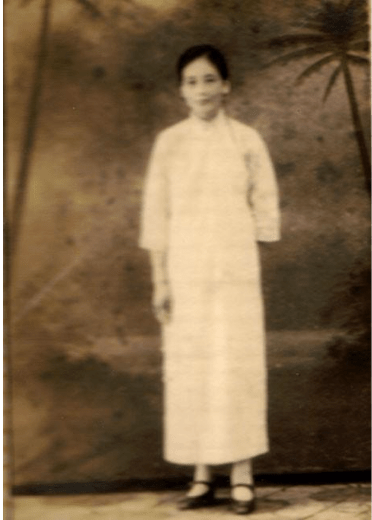
I remembered this day when the family was notified of Aunt Hui-Zheng’s passing. After I was back from school, my mother showed me a letter from my father. I started crying. On the dining table, there was still a package of glucose powder ready to mail to Aunt Hui-Zheng for her food supplement.
After Aunt Hui-Zheng passed away, Aunt Yin made a trip to Tai Shang to handle her sister’s personal belongings in the convent. Aunt Yin was nearly out of her breath when she read her sister’s Death Certificate. The certificate claimed her political status as Convicted Anti-revolutionist. It also recorded that the Cause of Death was liver disease. The nun sisters in the convent told my aunt Yin about Aunt Hui-Zheng’s health conditions prior to her death. She was incapacitated in extreme weakness with severe whole body edema. Aunt Yin had no doubt that her sister died of starvation. The notorious nationwide Great Famine lasting from 1958 to 1960 had taken lives of 30 millions in China. As a physician, Aunt Yin had helplessly watched so many deaths from starvation. She witnessed the scene of those nun sisters having a meal that was shares of a single piece of sweet potato. It was in those days that the harshest deprivations were justified to impose upon those under political persecution. Aunt Hui-Zheng’s suffering in those years was beyond words.
In 1971 while I stayed in Beihai, Aunt Yin told me about her attempt, years ago, to have her elder sister Hui-Zheng come to Beihai when she learned about her sister’s health conditions. Aunt Hui-Zheng agreed, but she also requested to bring one of her nun sisters together with her. This request led to Aunt Yin’s attempt in vain. Had her elder sister come to be with her in Beihai, sister Hui-Zheng would not have starved to death, Aunt Yin recounted sorrowfully.
I remembered two occasions that I spent times with Aunt Hui-Zheng. In the year of grandpa’s passing, I was still a 4 year-old toddler. After a bath, Aunt Hui-Zheng fetched a dry towel as she saw water dripping from my hair. She started telling me a story while drying my hair. It was a children’s tale. There was a drought. The fruit plants in a garden were dying. The farmer used bamboo to build a water-lift and water ducts. Water then was able to flow from a small river to the garden. Plants were no longer thirsty, and gave a good harvest. The farmer was very happy. He praised the fruit plants. Hearing the farmer’s praise for the plants, the river felt it was unfair as the farmer did not mention the river. The river cried out: if I did not give the water, the plants would have died. Then the water duct rang out: Without me, water had no way to reach the garden. The water-lift also argued: Only because of me, water could flow into the duct. Each claimed their roles more critical than other’s. At the end, Aunt Hui-Zheng asked me:” Can you tell me whose work was most important for the harvest?” Confused, I did not have a word for an answer. Aunt Hui-Zheng smiled but did not explain. I was bewildered by the question for a long while. For a few days, I avoided Aunt Hui-Zheng as I was afraid that she might ask me for the answer again. The second occasion was in 1955. Aunt Hui-Zheng stayed in Jie Shi for a short period after grandma passed away. I was then a third-grade elementary student. One day my mother went visiting Aunt Hui-Zheng, taking me and my younger brother with her. Amid their chatting, my mother, after setting her eyes on us for seconds, turned to Aunt Hui-Zheng: I am very concerned about these children. They would grow up without knowing our God. Aunt Hui-Zheng said in response: Do not worry. As long as seeds were sowed, they will grow sooner or later. As she spoke, Aunt Hui-Zheng handed me a portrait of Jesus Christ. It was a full body portrait in the size of a match box. She said to me: Niece, please take a close look. Do you notice how graceful he is. He is our lord Jesus Christ. At that time I had no idea about this Jesus, and this portrait was lost soon afterward. However, what Aunt Hui-Zheng Said to me about Jesus Christ has always lingered in my mind. During the ten-year “Culture Revolution”, I finally opened my heart to Jesus. The seed that Aunt Hui-Zheng planted in me has sprouted and grown strong. Ever since, I have had hope and peace. I have also come to understand more about Aunt Hui-Zheng’s life.
After the “Culture Revolution” came to an end in1976, my elder sister Gui-Hui was a psychiatrist in a university hospital in Guang Zhou. One of her patients was the city mayor from Tai Shang where Aunt Hui-Zheng’s convent used to be. My sister asked the mayor to help locate Aunt Hui-Zheng’s burial site. The mayor’s assistant was able to obtain the information from the Da Jiang Christian Church in the Town of Da Jiang. With the help of the mayor’s assistant, my sister Gui-Hui made a trip to Tai Shang, and paid homage to Aunt Hui-Zheng at her burial site. My sister reported to the Lin family after her trip that the grave stone had been preserved well. My sister also spotted at the front of Aunt Hui-zheng’s tomb, there was a bouquet from a Hong Kong Christian organization. The details of the life inside the convent,
the activities of Aunt Hui-Zheng and her nun sisters have been unclear as time goes by. However, as I conjure her grace, intelligence and kindness, I have no doubts that she must have been the most respectable Christian among her nun sisters and a leader in the Tai Shang Convent.
In a civil society, people should have the freedom for their beliefs and faiths. Aunt Hui-Zheng chose to devote her life to Jesus Christ. In an unspeakably harsh environment, to the end of her life, she refused to surrender her faith to the politically indoctrinated society. For her pursuit, she was brutally persecuted. It is even more unfortunate that her suffering has, time after times, been misconstrued in our extended Lin family.
It was very well said by my father, what had led Aunt Hui-Zheng to her destiny were her pure soul and her unwavering faith. Women in our Lin family had been very brave under critical circumstances. They had never backed down from taking responsibilities and accepting challenges. It was the year when political persecutions spurred every corner of this nation, and grandma was severely ill, her sons and daughters, scattered far around the country, were all frightened for their own survival, it was Aunt Hui-Zheng who stood alone to take care of grandma until the very end. It is my opinion that every descendent of Grandma is indebted to Aunt Hui-Zheng. Our gratitude to Aunt Hui-Zheng shall be passed on, and her deeds of bravery will be commemorated.
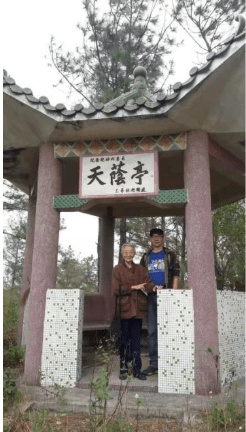
Caption: Gui-Hui and her son Nian-JI paid homage to Aunt Hui-Zheng in 2005(?). The tomb stone is inscribed: “Beloved Sister- Hui-Zheng Lin, Tribute from Chan Lin and Yin Lin”. The tomb was relocated and rebuilt in late 90s. The board on the upper-front of the pagoda reads “Tian Yin Tin (Tent of Heavenly Asylum), For the Memoriam of Sister Hui-Zheng Lin, From Chan Lin (the contributor). Aunt Hui-Zheng used another name, En-Yin Lin, when she was in Da-Jiang-Yu Christian Convent of Tai Shang. After the end of “Culture Revolution” in 1976, the succeeding government has skewed its policies much more lenient, even friendly towards Christianity. The dynastic concept of gripping power by political persecutions against ordinary folks in common places seems no longer the favored policy of the new administration. Thanks to the change, we can pay our homage to Aunt Hui-Zheng without fears –Baixi Lin
Translation completed on October 29, 2020 by Baixi Lin and proofreading rendered by Ginnie
 PurenHealthInfo.com